How Do You Manage a Flag Football Playbook Without Overwhelming Youth Players?
Coaching youth flag football should be fast, exciting, and fun for both coaches and players.
Yet, one of the most common hurdles youth coaches face isn’t designing a great play. It’s managing the playbook software and preventing information overload.
Coaches often ask, “How many plays should my flag football team have?” This article will help you.
As the season progresses, coaches naturally want to change things that may not be working. However, introducing too many formations, overly complex terminology, or clunky digital playbooks can cause young athletes to hesitate on the field.
Whether you are competing under NFL FLAG, USA Football, club, high school, college, or international IFAF (International Federation of American Football) rulesets, the most effective playbook isn’t the largest one. It is the one your players can understand, remember, and execute at full speed.
What Makes Flag Football Playbook Software So Hard to Manage?
Before diving into how to structure your plays, it is critical to understand why so many coaches struggle with playbook management in the first place.
Most digital playbook tools on the market were engineered specifically for 11v11 tackle football. When applied to 4v4,5v5, 6v6, 7v7, or 8v8 flag football, traditional football software isn’t ideal:
- Tackle Football Field Bias: Forcing a 5v5 flag play onto a software canvas built for an 11v11 tackle field distorts player spacing, hash mark alignment, and route geometry.
- Inability to Account for Rule Restrictions: Governing bodies like IFAF and USA Football enforce strict field rules, such as the 7-yard rush line and 5-yard no-run zones. Tackle football play software does not allow coaches to visually plot or filter plays by these specific rule constraints.
- Clunky, Time-Consuming Drawing Tools: Drawing custom route trees, rub concepts, or center snaps on non-intuitive desktop platforms takes hours. Time youth coaches simply don’t have.
- Distribution Fatigue: Exporting raw PDFs or forcing 8-year-olds (and their parents) to navigate complex software logins leads to lost play cards, outdated versions, and pre-game confusion.
How Flag Football Rules Shape Playbook Management
Unlike tackle football, flag football relies heavily on speed, spatial awareness, and quick decision-making. Because rules strictly ban physical contact, blocking, and screening, success comes down to route execution and leverage.
To manage your playbook effectively, your structure must directly reflect the official rules of your league
Before designing your first play, familiarize yourself with your league’s rulebook. Ask yourself:
- How many flag football players are on the field?
- Are there no-run zones?
- How many players can rush?
- Is blitzing allowed from any position?
- Can the quarterback run?
- Are laterals and handoffs permitted?
- What are the field dimensions?
- Is motion allowed before the snap?
Quarterback Run Rules
Some leagues allow quarterbacks to run freely, while others require a handoff or lateral before crossing the line of scrimmage.
If quarterbacks cannot run:
- Build more RPO-style handoffs.
- Incorporate shovel passes and jet sweeps.
- Use quick passing concepts to replace quarterback scrambles.
If quarterbacks can run:
- Add designed QB draws.
- Include bootlegs and rollouts.
- Create read-based concepts that force defenders to choose.
No-Run Zones Change Everything
Many youth leagues feature no-run zones near the goal line or midfield. Instead of relying on power runs, coaches should install:
- Quick slants
- Pick concepts (within league rules)
- Mesh routes
- Corner routes
- Sprint-out passing concepts
Having an organized “No-Run Zone” section in your playbook saves valuable time during games.
Rushing Rules Influence Protection
Different leagues have different rushing rules.
Examples include:
- One designated rusher
- Rush from seven yards
- Multiple rushers allowed
- Delayed blitzes
- Free rush after a set count.
Field Size Changes Route Design
Field dimensions vary dramatically across flag football.
Smaller fields require:
- Faster developing plays
- Short crossing routes
- Rub concepts
- High-percentage completions
Larger fields allow:
- Deep posts
- Vertical concepts
- Flood routes
- Double moves
The same playbook shouldn’t be used for every field size.
Motion Rules Create Opportunities
Some leagues allow continuous motion before the snap, while others only permit limited movement.
Motion helps coaches:
- Identify man or zone coverage.
- Create leverage before the snap.
- Generate speed for jet sweeps.
- Force defensive communication.
If your league allows motion, dedicate a section of your playbook to motion-based formations and concepts.
Defensive Rules Matter Too
Defensive playbooks should also reflect league rules.
Ask questions like:
- Can defenders jam receivers?
- How many players may rush?
- Can defenders blitz from anywhere?
- Is contact allowed after five yards?
How to Build a Youth-Friendly Playbook
Instead of organizing your playbook like an NFL franchise, structure it around kids’ learning retention.
Step 1: Limit How Many Plays (10–20 Core Plays)
A youth team rarely needs more than 10 well-rehearsed plays. Ten to twenty core concepts executed with confidence will outperform 60 plays that players struggle to recall under pressure.
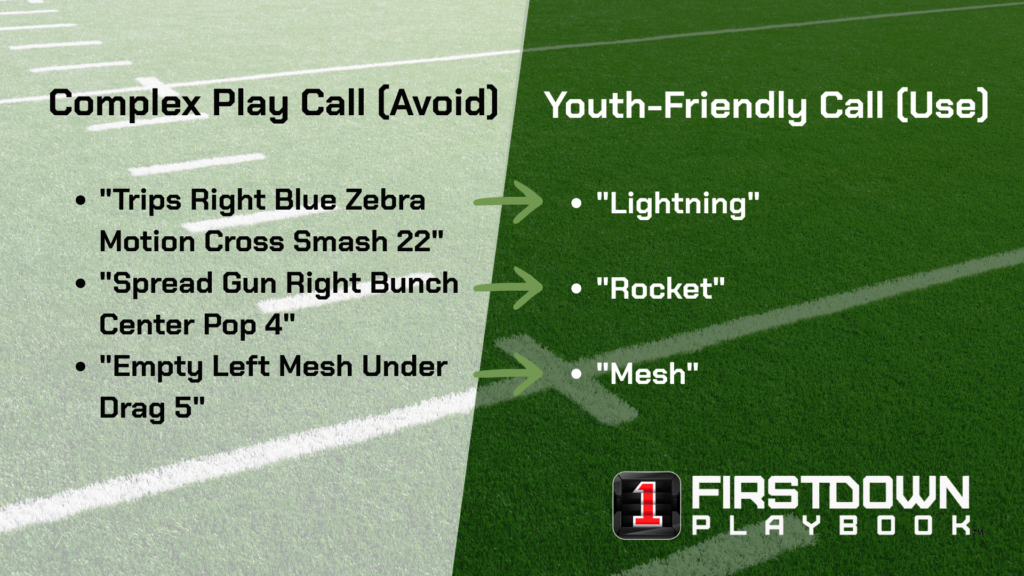
Step 2: Simplify Terminology
Replace multi-word play calls with single, memorable words.
Step 3: Start with 1–2 Base Formations
Teach alignment first. Once young athletes instantly know where to line up (e.g., Spread vs. Bunch), adding a new route concept takes seconds rather than minutes of practice time.
Step 4: Rely on Color-Coded Visual Cards
Young athletes are visual learners. Use high-contrast diagrams with clear route lines, color-coded player positions, and obvious primary receiver cues. This approach should be taken with play diagrams and play wristband sheets.
Generic Tackle Software vs. FirstDown PlayBook
How FirstDown PlayBook Solves Flag Football Playbook Management
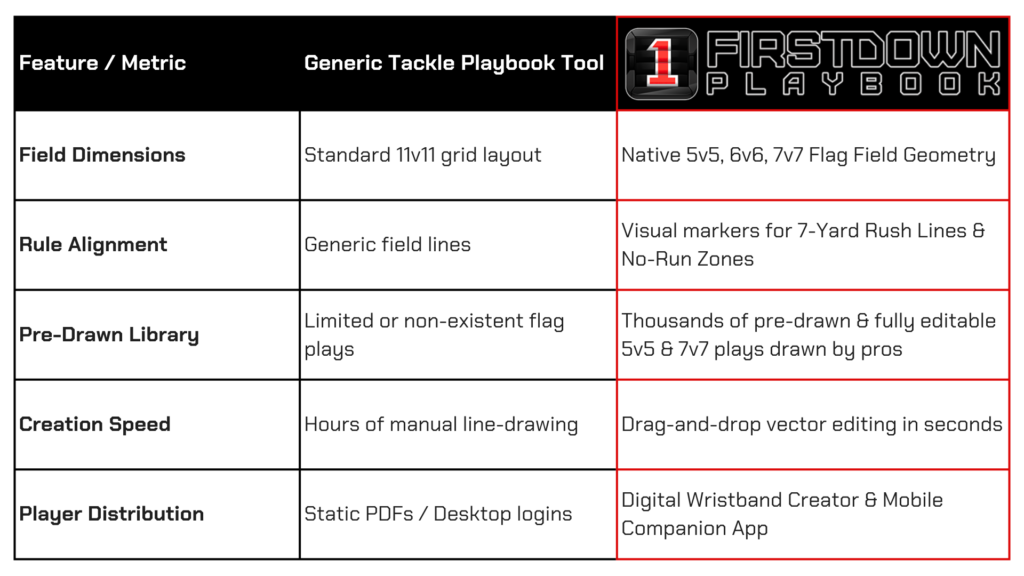
At FirstDown PlayBook, we have spent over 16 years building football playbook software designed for real coaching workflows. We recognize that flag football is a distinct sport with its own field dimensions, spatial requirements, and governing rules.
FirstDown PlayBook gives flag football coaches the exact tools needed to keep playbooks organized and youth players confident:
- Purpose-Built Flag Templates: Instantly design plays on true 5v5, 6v6, and 7v7 field dimensions with accurate hash marks and goal-line geometry.
- Thousands of Pre-Drawn, Editable Plays: Never start from scratch. Choose from a massive library of flag concepts built by former professional and collegiate coaches, then adapt them to your team’s terminology in seconds. Every NFL Flag & IFlag Play is in FirstDown PlayBook too.
- Rule-Specific Organization: Easily tag and filter plays by field position (e.g., Standard Scrimmage, No-Run Zone, or Extra Point Conversions).
- One-Click Wristband Creator: Export full-color, customized wristband inserts directly from your digital playbook so players can check assignments on their wrists without taking time off the clock.
- Mobile Field Access: Share plays digitally with assistant coaches and parents through the FirstDown PlayBook app, ensuring everyone operates from the exact same page.
Frequently Asked Questions
What makes flag football playbook software hard to manage?
Most playbook software is built for 11v11 tackle football. Forcing flag plays onto tackle templates leads to distorted field geometry, clunky drawing interfaces, and an inability to map flag-specific rules like the 7-yard rush line or 5-yard No-Run Zone.
How many plays should a youth flag football team have?
Most youth teams (ages 6 – 14) perform best with 10 to 20 core plays. Mastering a small package run out of 1 or 2 formations builds execution speed much faster than memorizing a massive playbook. Using wrist coaches can help manage the playbook for young players.
How do USA Football, NFL FLAG, and IFAF rules affect playbook design?
Because USA Football, NFL Flag, and IFAF rules enforce non-contact play, 5-yard No-Run Zones, and a 7-yard rush line, playbooks must focus heavily on quick-release pass routes, precise route spacing, and quick timing rather than physical power.
What is the best way to distribute playbooks to youth players?
Avoid printing thick paper binders. Use clean visual play cards, mobile-friendly app with direct to player notifications, and physical wristband inserts so players can quickly reference their responsibilities on game day.
Start Building Your Youth Flag Football Playbook
Managing a youth flag football playbook isn’t about accumulating more plays than your opponent. It’s about giving young athletes the clarity and confidence to play fast.
When you simplify your terminology, align your playbook with official NFL Flag, USA Football, and IFAF rules, and leverage software purpose-built for flag football like FirstDown PlayBook, you eliminate game-day confusion, allowing your players to focus on making plays and having fun.
FirstDown PlayBook offers a free trial for coaches who want to check out the extensive library of flag football plays and test out the time-saving features that make your life easier.